



Events featuring this statue
November 2026
Description
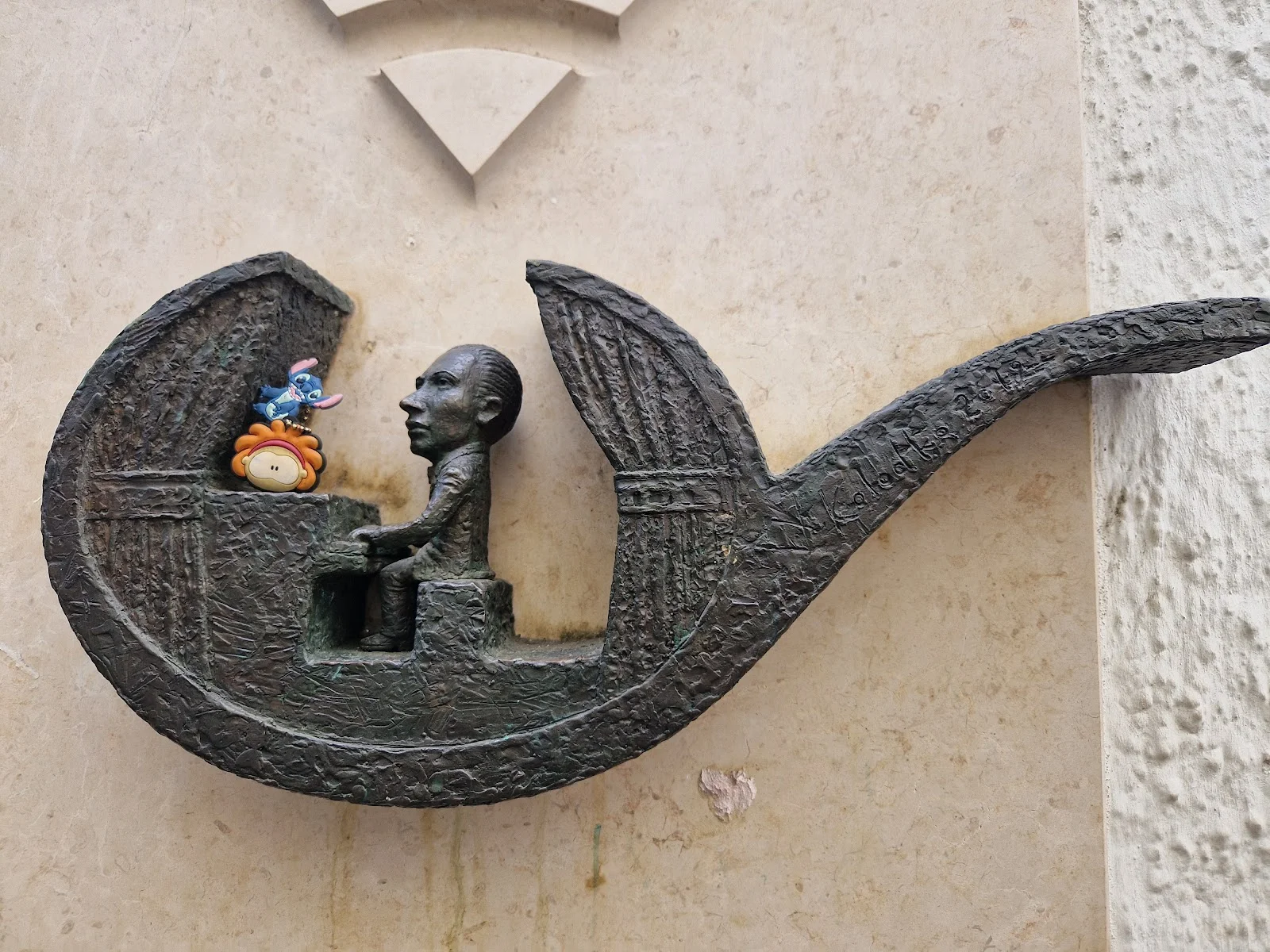
The artwork relies on a brilliant visual illusion. When viewed from a distance in profile, the metal object fixed to the wall resembles a classic, curved-stem tobacco pipe. This is a direct nod to the name of the venue, Kispipa (meaning "Little Pipe"). As you step closer, the silhouette of the pipe dissolves to reveal the true scene: the bowl of the pipe transforms into the body of a piano, while the curve of the stem forms the figure of Rezső Seress, hunched over the instrument and deeply lost in his performance.
Story
From the 1930s until his death in the 1960s, Rezső Seress was an iconic figure of Budapest's hospitality scene. Although he gained worldwide fame through Gloomy Sunday—with stars like Billie Holiday and Ray Charles adding it to their repertoire—the composer never traveled to America to collect the massive royalties accumulated in the New York copyright office. Instead, he chose to stay at his home ground, the Kispipa Restaurant on Akácfa Street. There, playing only with his right hand (as he never actually learned to read sheet music or play the piano properly), he entertained the local crowd and visiting international celebrities for decades. Mihály Kolodko captured this loyalty and the spirit of the place in September 2019, clandestinely mounting the artwork onto the building's outer wall after the restaurant had closed down and changed functions.
Fun facts
- • The global hit the author never heard abroad: Seress was so terrified of flying and traveling that he never left Budapest for the rest of his life, only learning about his own international success from the stories of foreign guests visiting Kispipa.
- • The genius of a musical amateur: The figure sitting behind the piano on the statue is a man who played strictly by ear, using a self-taught method—yet became the father of one of the most covered melodies of the 20th century.
- • A modern twist in the past: Instead of a sheet of paper, the piano's music stand features the stylized shape of a tiny smartphone screen—a playful jab by Kolodko aimed at today's generation that consumes everything instantly and digitally.


