




Description
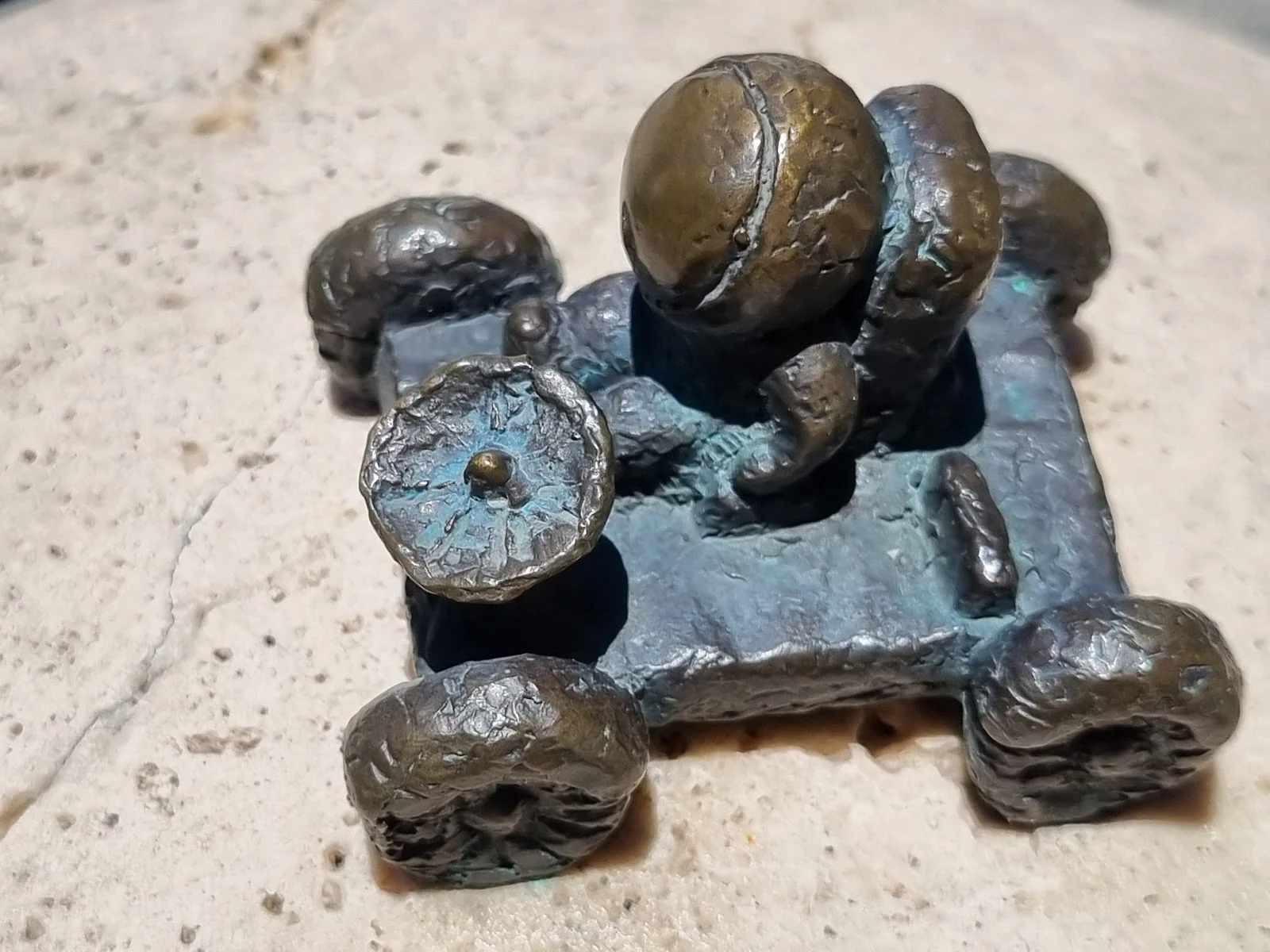
Kolodko Mihály’s miniature sculpture on Hold Street depicts a tiny lunar rover that blends almost seamlessly into its urban surroundings. Despite its small size and simple appearance, the vehicle represents much more than a piece of space exploration technology. It evokes Hungarian engineering ingenuity, scientific curiosity and humanity’s enduring desire to explore the unknown. The location itself is part of the artwork’s message. The name of Hold Street, the nearby lunar motif and Kolodko Mihály’s personal connection to the area combine to complete the concept. The sculpture is therefore not just a tribute to science, but also a little urban puzzle that rewards anyone willing to stop and take a closer look.
Story
Ferenc Pavlics – The Man Who Put Wheels on the Moon When the astronauts of Apollo 15 first drove across the lunar surface in 1971, the work of a Hungarian engineer was right there with them. Ferenc Pavlics worked on the development of the lunar rover in the United States and played a key role in designing its specially engineered wheels. Built for the challenging conditions of the Moon, they allowed astronauts to cover much greater distances and carry out more scientific investigations. The technology proved its worth on more than one mission: the lunar rovers used during Apollo 16 and Apollo 17 also featured Pavlics’s wheel design. His contribution was recognised with a NASA award in 1971. Zoltán Bay – When the Moon Answered Back Another Hungarian scientist, Zoltán Bay, found his own way to reach the Moon. A physicist, he led an experiment on 6 February 1946 in which researchers successfully detected radio waves reflected from the lunar surface. The experiment was conducted by a research team at Tungsram, in the difficult conditions of post-war Hungary. It marked an important milestone in the history of radar astronomy. By analysing the returning signals, scientists were able to determine the distance between the Earth and the Moon. Humanity was no longer merely observing its celestial neighbour: it was sending signals towards it and detecting the response. Two scientists, two different eras, and two remarkable achievements – both proving that Hungarian scientific ingenuity has left its mark far beyond the boundaries of Earth.
Fun facts
- The lunar rover served on three missions. The wheel technology developed with Ferenc Pavlics’s contribution was used on the Apollo 15, Apollo 16 and Apollo 17 missions. The rovers remained on the Moon after their missions ended.
- Zoltán Bay’s experiment took place in difficult times. The successful detection of radio waves reflected from the Moon came barely a year after the siege of Budapest. A similar experiment had been conducted in the United States somewhat earlier, but the Hungarian research team’s achievement remains a significant scientific milestone.
- Kolodko Mihály has a personal connection to the location. His first home in Budapest was rented on Hold Street, giving the sculpture’s setting a special meaning for the artist.


